I was just up in Canada this weekend participating in the Whistler Gran Fondo Forte cycling event. Whew…incredibly challenging, beautiful, and rewarding all packaged in 6 hours on my

Dated: July 21 2026
Views: 173
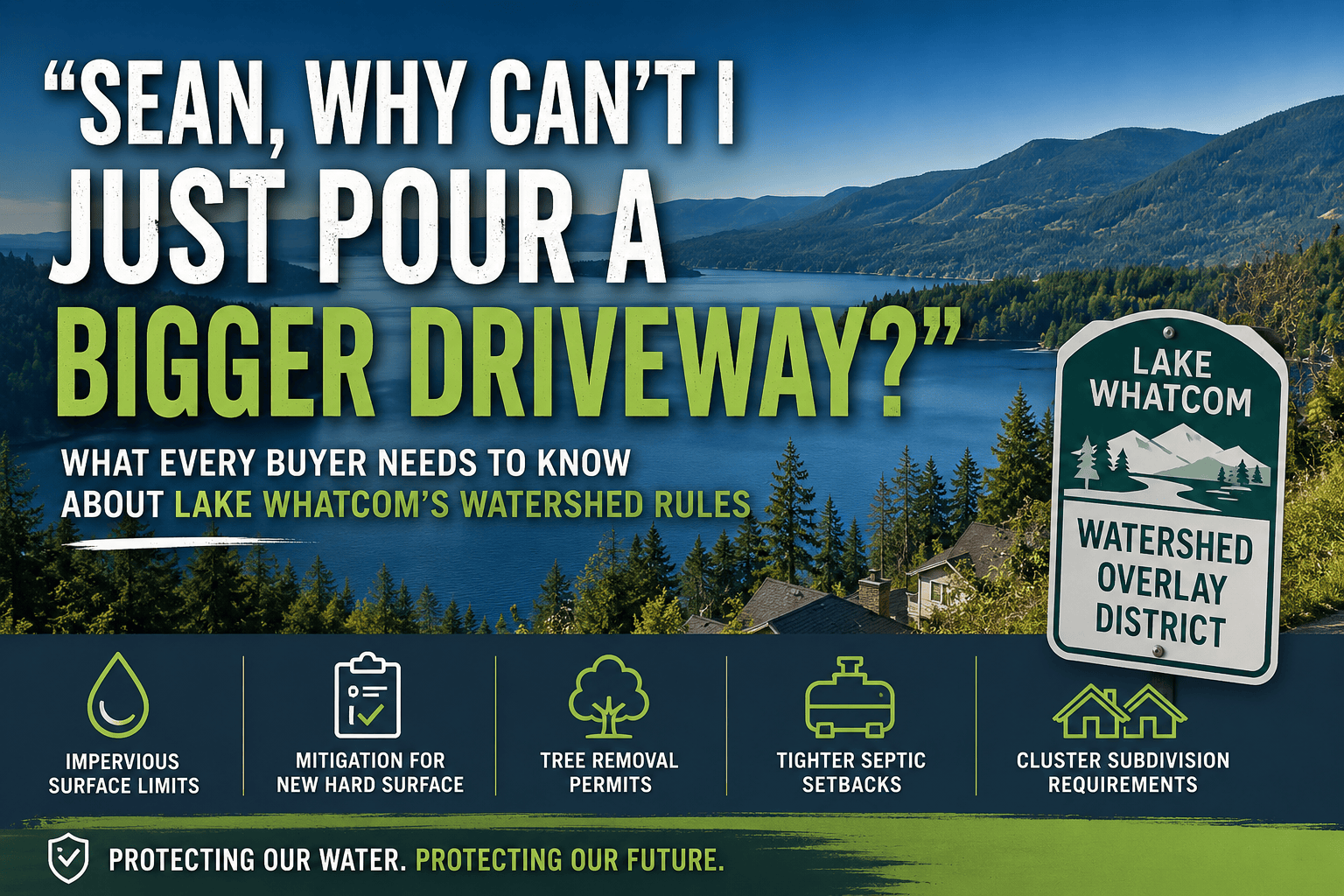
"Sean, why can't I just pour a bigger driveway?"
A buyer asked me that this spring, standing in the yard of a place near Silver Beach with a great view of Lake Whatcom and about eight feet of gravel where he wanted a proper parking pad.
The answer surprised him. His new home wasn't just inside city limits — it was inside the Lake Whatcom Watershed Overlay District. And that changes what you can and can't do with a property, sometimes in ways buyers don't discover until well after closing.
If you're looking at a home anywhere near the lake — Silver Beach, Sudden Valley, Geneva, or the hillside neighborhoods above it — this is worth understanding before you write an offer, not after.
I personally live in the Lake Whatcom Watershed, so here's what I can tell you.
Why the Watershed Has Its Own Rules
Lake Whatcom is the drinking water source for roughly 100,000 people in Bellingham and Whatcom County. That's why the county and the city both regulate what happens on land that drains into it more closely than almost anywhere else in the area.
The rules live in what's called the Lake Whatcom Watershed Overlay District. I walk almost every buyer looking near the lake through the same short list of things that catch people off guard.
- Impervious surface limits. Most lots in the watershed are capped at somewhere between 10% and 20% of the total lot area, or 2,500 square feet, whichever is greater. Your driveway, patio, shop roof, and house footprint all count together.
- Mitigation for new hard surface. Add more than 200 square feet of new hard surface — a garage pad, a deck, an expanded driveway — and you'll likely need a mitigation plan before the county signs off.
- Tree removal permits. Taking down a tree on a watershed lot generally requires a permit, even on your own property, unless it's part of an already-approved project.
- Tighter septic setbacks. Whatcom County has around 700 homes in the watershed still on septic, and those systems face stricter setback rules than standard county requirements.
- Cluster subdivision requirements. If you're eyeing a larger parcel with hopes of splitting it, lots under five acres in the watershed are generally required to cluster rather than divide conventionally.
None of this means you shouldn't buy near the lake. I've sold plenty of waterfront and near-waterfront homes in this area, and most buyers make it work just fine. It just means your "I'll add a shop later" plan needs a phone call to the county before it becomes part of your offer strategy.
It Depends Which Side of the Line You're On
Here's the part that trips people up: the exact rules that apply depend on whether the home sits inside Bellingham city limits or out in unincorporated Whatcom County.
Two homes half a mile apart, both technically "near the lake," can be governed by different departments with different permit processes.
Before you get attached to a property near Lake Whatcom, I always recommend confirming which jurisdiction it falls under and pulling the parcel's specific watershed designation. It's a five-minute call, and it can save you a very frustrating conversation with a contractor six months after closing.
Watershed Fees Are Going Up Through 2028
There's also a cost side to this that's worth knowing about now.
Bellingham's city council approved a three-year utility rate schedule that took effect January 1, 2026 — a 13.5% increase this year, with roughly 11% more in both 2027 and 2028. For an average single-family home, that's an estimated $18 to $25 more per month on the base utility bill.
On top of that, homes in the watershed pay a separate Lake Whatcom Watershed Protection Fee — $18.13 a month for single-family service through 2028. That fee funds the city's ongoing program to buy and preserve land around the lake to protect the water supply.
None of this is a reason to walk away from a home you love near the lake. But it's a real number that belongs in your monthly cost comparison, right alongside your mortgage payment and property taxes — not something you find out about on your first utility bill.
Frequently Asked Questions
Is it harder to get a building permit near Lake Whatcom?
Not harder exactly, but there are more steps and money. Projects that add hard surface, remove trees, or expand a septic system typically need extra review under the Watershed Overlay District rules, on top of standard building permits.
Can I still add an ADU to a home in the watershed?
Often, yes — but your impervious surface limit still applies, and it can get tight once an ADU is added to the math. It's worth checking your specific lot's numbers before you count on the extra space.
Does the watershed fee apply if I'm outside city limits?
It can. The watershed protection fee is based on watershed boundaries and service area, not strictly on city limits, so a home in unincorporated Whatcom County near the lake may still owe it. Confirm with the specific parcel before you assume either way.
Are all homes near Lake Whatcom on septic?
No. Some areas are connected to sewer, and the county has been prioritizing septic-to-sewer conversions in higher-risk spots. But a meaningful number of homes — around 700 as of the most recent count — are still on septic with the tighter watershed setbacks.
Ready to Look at a Property Near the Lake?
If you've got your eye on a home near Lake Whatcom — Silver Beach, Sudden Valley, or anywhere along that shoreline — I'm happy to pull the watershed designation and walk you through what it means for that specific parcel before you write an offer.
I've watched Bellingham's population growth push demand into these areas for years, and the lake continues to be one of the most asked-about parts of town. You can also see more local market breakdowns on my YouTube channel (youtube.com/@LivinginBellingham) or read what past clients have said at seanhackneyreviews.com.
No pressure. No obligation. Just real answers so you know what you're buying.
About Sean Hackney
Sean Hackney is a Bellingham-based REALTOR® with 23 years of experience specializing in luxury, waterfront, and historic properties throughout Whatcom County. Affiliated with NextHome NorthWest Living, Sean brings deep local knowledge and a relationship-first approach to every transaction. Watch Sean's local market videos at youtube.com/@LivinginBellingham, read client reviews at seanhackneyreviews.com, or connect at seanhackneyhomes.com.

Sean Hackney: Your Family-Focused Realtor® Specializing in Relocation, Listings, and Buyers in Whatcom and Northern Skagit Counties Greetings! I'm Sean Hackney, a devoted husband, father, and co-....
I was just up in Canada this weekend participating in the Whistler Gran Fondo Forte cycling event. Whew…incredibly challenging, beautiful, and rewarding all packaged in 6 hours on my
"Sean, I heard you can buy a house here with zero down. Is that actually true?"I get this question a lot from first-time buyers, especially the ones who moved up from Seattle or King County and are
"Sean, the builder says they'll buy down my rate — is that basically free money, or is there a catch?"I get some version of this question every time a buyer starts looking at new construction
You've found the view. The dock's in decent shape, the bulkhead looks solid, and you're ready to write an offer.Here's what I tell every buyer looking at waterfront property in Whatcom County before
 Claims of Copyright Infringement & Related Issues
Disclaimer:
IDX information is provided exclusively for consumers' personal noncommercial use,
that it may not be used for any purpose other than to identify prospective properties
consumers may be interested in purchasing, that the data is deemed reliable but is not
guaranteed by MLS GRID, and that the use of the MLS GRID Data may be subject to an end user
license agreement prescribed by the Member Participant's applicable MLS if any and as amended
from time to time.
The information contained in this listing has not been verified by NextHome Northwest Living and
should be verified by the buyer.
The database information herein is provided from and copyrighted by the
Northwest Multiple Listing Service (NWMLS). NWMLS data may not be reproduced or
redistributed and is only for people viewing this site. Listings that feature the
"three tree" icon are provided courtesy of NWMLS. All information provided is deemed
reliable but is not guaranteed and should be independently verified. All properties
are subject to prior sale or withdrawal. All rights are reserved by copyright.
Based on information submitted to the MLS GRID as of September 22, 2026 4:36 PM UTC. All data is obtained
from various sources and may not have been verified by broker or MLS GRID.
Supplied Open House Information is subject to change without notice.
All information should be independently reviewed and verified for accuracy.
Properties may or may not be listed by the office/agent presenting the information.
Some IDX listings have been excluded from this website.
Copyright 2026 Northwest Multiple Listing Service. All rights reserved.
