I was just up in Canada this weekend participating in the Whistler Gran Fondo Forte cycling event. Whew…incredibly challenging, beautiful, and rewarding all packaged in 6 hours on my

Dated: July 1 2026
Views: 201
Lately, I've been hearing the same question from a lot of buyers.
"Sean, can I build a rental unit on the property if I buy it?"
Or...
"I've heard the ADU rules changed. Does that make buying a home more affordable?"
The answer is...
Maybe.
And for the right buyer, it can completely change the numbers.
Washington recently updated its ADU laws, and Bellingham has followed with changes of its own. If you're buying a home in Whatcom County, these new rules create opportunities that simply didn't exist a few years ago.
Let's talk about what changed—and why buyers are paying attention.
An ADU, or Accessory Dwelling Unit, is simply a second living space on a property.
It could be:
Whatever you call it, the idea is the same.
It's a separate living space that can provide housing for family members—or generate rental income.
This is the part that's getting everyone's attention.
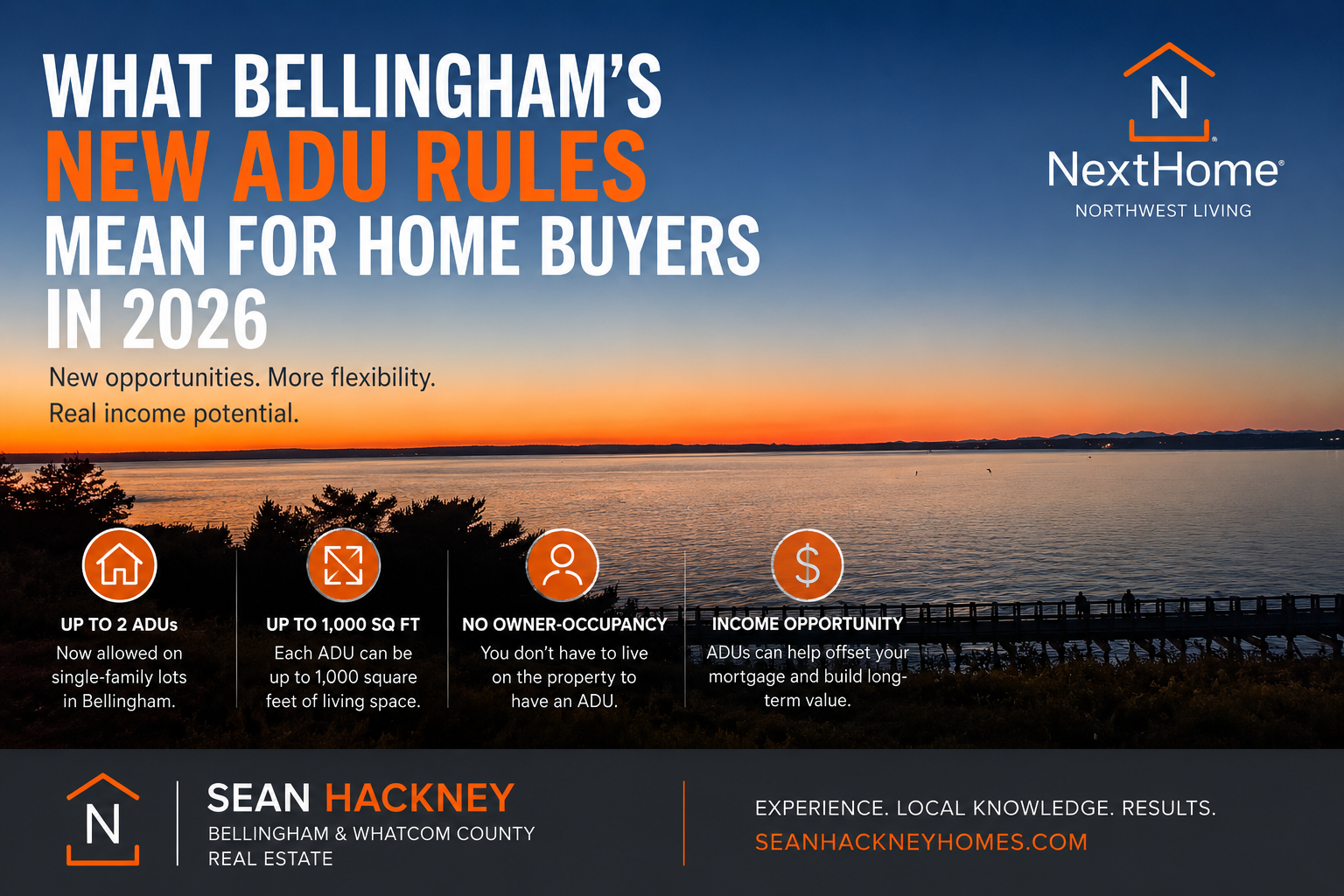
Washington State passed HB 1337, and Bellingham updated its local regulations to make ADUs easier to build in many situations.
Some of the biggest changes include:
Now, that doesn't mean every property qualifies.
Zoning still matters.
Lot size still matters.
And if you're buying near the Lake Whatcom watershed, there are additional restrictions you'll want to understand before making plans.
That's why I always encourage buyers to verify what's allowed on a specific property rather than assuming every lot is the same.
Honestly...
It's not because everyone suddenly wants to become a landlord.
It's because housing has gotten expensive.
If you've been shopping for homes in Bellingham lately, you already know that.
Many buyers are looking for creative ways to make the monthly payment more manageable.
That's where an ADU can become really interesting.
Imagine purchasing a home and adding a detached backyard cottage that rents for $1,500 a month.
Or buying a property that already has a legal basement apartment producing income.
Suddenly, the monthly numbers may look very different.
For some buyers, that rental income can make homeownership much more realistic.
I usually encourage buyers to think about this in two different ways.
This is often the simplest path.
The work has already been done.
Depending on your loan program, your lender may even allow some of that existing rental income to help you qualify.
Every loan is different, so it's worth having that conversation early.
This option gives you flexibility.
Maybe you don't need the extra income today.
But a few years from now?
Life changes.
You might have aging parents.
Adult children moving back home.
Or maybe you'd simply like an additional source of income.
Having that option can add long-term value to the property.
Before you get too excited, there are a few realities.
Building an ADU isn't inexpensive.
You'll still need permits.
Construction costs are significant.
Utility connections can add expense.
And not every lot will qualify.
That's why I always tell buyers not to fall in love with the idea before we verify what's actually possible.
A quick conversation now can save a lot of frustration later.
If your property already has a permitted ADU—or has strong potential for one—that can absolutely be an attractive feature in today's market.
More buyers are actively searching for:
Those features weren't nearly as common five years ago.
Today, they're becoming a major selling point.
That said, if your ADU isn't permitted, or if you're advertising future development potential, it's important to be accurate.
Every property is different, and buyers are doing their homework.
One of the biggest mistakes I see buyers make is assuming every property has the same potential.
They don't.
Some lots are fantastic candidates for an ADU.
Others aren't.
Before you make an offer because you're imagining a future rental unit, let's verify what's actually allowed.
That's a much better conversation to have before you're under contract than after you've already fallen in love with the house.
If you're considering a property because of its ADU potential—or you're wondering whether an existing ADU changes the value of a home—I'd be happy to help you evaluate the possibilities.
We'll look at zoning, neighborhood, resale value, rental potential, and whether the property fits your long-term goals.
No pressure.
No obligation.
Just honest advice so you can make an informed decision.
—
Sean Hackney
NextHome NW Living
Bellingham & Whatcom County Real Estate

Sean Hackney: Your Family-Focused Realtor® Specializing in Relocation, Listings, and Buyers in Whatcom and Northern Skagit Counties Greetings! I'm Sean Hackney, a devoted husband, father, and co-....
I was just up in Canada this weekend participating in the Whistler Gran Fondo Forte cycling event. Whew…incredibly challenging, beautiful, and rewarding all packaged in 6 hours on my
"Sean, I heard you can buy a house here with zero down. Is that actually true?"I get this question a lot from first-time buyers, especially the ones who moved up from Seattle or King County and are
"Sean, the builder says they'll buy down my rate — is that basically free money, or is there a catch?"I get some version of this question every time a buyer starts looking at new construction
You've found the view. The dock's in decent shape, the bulkhead looks solid, and you're ready to write an offer.Here's what I tell every buyer looking at waterfront property in Whatcom County before
 Claims of Copyright Infringement & Related Issues
Disclaimer:
IDX information is provided exclusively for consumers' personal noncommercial use,
that it may not be used for any purpose other than to identify prospective properties
consumers may be interested in purchasing, that the data is deemed reliable but is not
guaranteed by MLS GRID, and that the use of the MLS GRID Data may be subject to an end user
license agreement prescribed by the Member Participant's applicable MLS if any and as amended
from time to time.
The information contained in this listing has not been verified by NextHome Northwest Living and
should be verified by the buyer.
The database information herein is provided from and copyrighted by the
Northwest Multiple Listing Service (NWMLS). NWMLS data may not be reproduced or
redistributed and is only for people viewing this site. Listings that feature the
"three tree" icon are provided courtesy of NWMLS. All information provided is deemed
reliable but is not guaranteed and should be independently verified. All properties
are subject to prior sale or withdrawal. All rights are reserved by copyright.
Based on information submitted to the MLS GRID as of September 22, 2026 4:36 PM UTC. All data is obtained
from various sources and may not have been verified by broker or MLS GRID.
Supplied Open House Information is subject to change without notice.
All information should be independently reviewed and verified for accuracy.
Properties may or may not be listed by the office/agent presenting the information.
Some IDX listings have been excluded from this website.
Copyright 2026 Northwest Multiple Listing Service. All rights reserved.
